Less Busywork. Smarter Systems. Better Results
You don’t need another piece of software. You need a solution that works for you.
Artificial intelligence is changing the way businesses operate, but knowing where to start, which tools to use, and how to turn an idea into something useful can be overwhelming.
That’s where I come in.
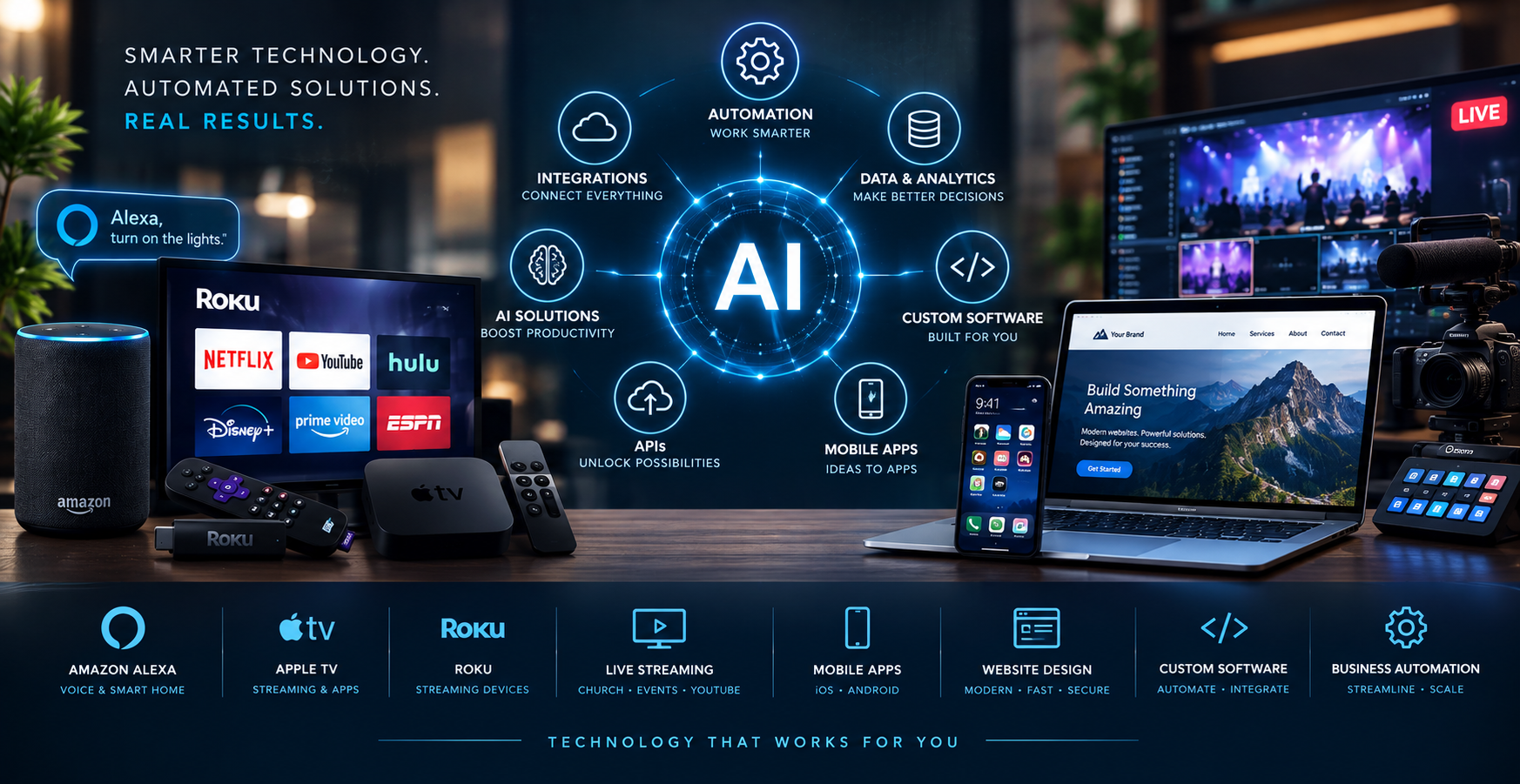
I help businesses identify opportunities, simplify complicated processes, integrate AI into their existing operations, and build custom technology that solves real problems. Whether you’re looking to automate repetitive tasks, develop an intelligent internal tool, build a custom AI application, or completely rethink how your organization gets work done, we can explore what’s possible and build a solution around your needs.
You don’t need to be a technology expert. You don’t need a perfectly defined plan. You just need a problem worth solving.
Let’s figure out what’s possible.
AI Should Do More Than Answer Questions. It Should Get Work Done.
AI is powerful on its own. Its real value emerges when it becomes part of a larger system that helps people accomplish their work.
I focus on practical applications of AI that help organizations work more efficiently, make better use of their information, reduce unnecessary manual effort, and create new capabilities that weren’t previously practical.
Depending on your needs, that might mean introducing AI into an existing workflow, building a custom application, connecting multiple systems, or developing an entirely new solution from the ground up.
AI Integration & Intelligent Workflows
Bring AI into the tools, processes, and systems you already use.
I can help you identify where AI makes sense, select an appropriate approach, and integrate it into your existing operations rather than forcing you to rebuild everything around a new platform.
Potential applications include:
- Automating routine administrative work and repetitive tasks.
- Summarizing documents, reports, correspondence, and other information.
- Extracting useful information from large collections of documents.
- Helping teams organize, search, and interpret internal knowledge.
- Assisting with research, analysis, reporting, and content creation.
- Connecting AI capabilities to existing applications and business processes.
- Developing workflows that combine AI with conventional software automation.
The goal isn’t to introduce AI simply because it’s popular. It’s to make your work easier, faster, or more effective where the technology can deliver meaningful value.
Custom AI Applications & Tools
Sometimes an off-the-shelf product doesn’t do what you need. Sometimes the process you’re trying to improve is unique to your organization.
That’s when a custom solution may make more sense.
I develop AI-powered applications and tools designed around specific problems, users, and workflows. These can range from focused utilities that eliminate a frustrating task to more comprehensive systems that bring multiple capabilities together in one place.
Examples of potential projects include:
- AI-powered assistants tailored to a specific business or industry.
- Custom dashboards that turn scattered information into actionable insights.
- Intelligent document-processing and information-retrieval tools.
- AI-assisted planning, scheduling, and recommendation systems.
- Internal applications that help employees find answers and complete tasks.
- Web-based tools that combine AI, databases, user accounts, and business logic.
- Purpose-built applications that connect your organization’s information to AI models.
Every solution starts with understanding the problem. From there, we determine what should be built, what can be integrated, and what will deliver the most practical result.
AI Knowledge Systems & Private Information Retrieval
Your organization may already have the information it needs to answer important questions. The challenge is finding the right information at the right time.
I can help develop systems that make organizational knowledge more accessible through AI-assisted search and retrieval.
Depending on your requirements, this may involve connecting language models to approved documents, technical references, policies, manuals, procedures, or other authorized information sources.
Potential capabilities include:
- Searching internal documents using natural-language questions.
- Retrieving relevant information from large document collections.
- Building knowledge assistants around approved reference materials.
- Helping users locate procedures, guidance, and technical information.
- Combining AI retrieval with existing databases and applications.
- Designing workflows that make it easier to trace answers back to their supporting sources.
These systems can be particularly useful when employees spend too much time searching for information or repeatedly answering the same questions.
For organizations with sensitive information, security requirements and data-handling restrictions must be considered from the beginning. Architecture, access controls, hosting, model selection, and deployment options all matter. Not every AI service is appropriate for every environment, and the solution must fit the organization’s actual security requirements.
Automation That Gives You Your Time Back
Not every problem needs artificial intelligence.
Many of the biggest efficiency gains come from connecting systems, eliminating duplicate data entry, and automating predictable processes that consume valuable time.
I help identify those opportunities and build workflows that allow information and tasks to move between systems with less manual intervention.
Business Process Automation
If you’re repeatedly performing the same task, copying information between applications, or manually coordinating a process that follows predictable steps, there’s a good chance we can improve it.
Automation opportunities may include:
- Moving information between connected applications.
- Generating reports from existing business data.
- Automating routine notifications and follow-ups.
- Organizing incoming information and routing it to the right destination.
- Reducing repetitive data entry and duplicate work.
- Automating document creation and routine administrative processes.
- Triggering workflows when specific events occur.
- Building tools that combine several manual steps into one process.
I can work with existing automation platforms and APIs where appropriate, or develop custom integrations when a more tailored approach is needed.
The objective is to eliminate unnecessary friction without creating a complicated system that’s difficult to maintain.
Connecting Your Existing Software
Businesses often rely on a collection of applications that were never designed to work together.
Your website, customer database, scheduling tools, reporting systems, and internal applications may each do their jobs well, but moving information between them can become a job of its own.
I help bridge those gaps.
Depending on the available interfaces and permissions, this can include:
- API integrations between business applications.
- Database connections and information synchronization.
- Website-to-backend integrations.
- Automated data collection and processing.
- Custom administrative dashboards.
- Integrations between AI services and existing software.
- User accounts, access controls, and application-specific workflows.
Sometimes the best solution is a simple integration. Other times, it’s a custom application that brings everything together.
Either way, your technology should support your workflow, not force you to work around it.
From an Idea to a Working System
Have an idea for an application, platform, or tool but don’t know how to turn it into reality?
I can help you move from an initial concept to a functioning technical solution.
My work can span planning, architecture, development, integration, testing, and deployment. Rather than stopping at a presentation or a theoretical recommendation, the objective is to create something you can actually use.
What I Can Build
AI-powered web applications
Web-based tools that combine user interfaces, AI capabilities, databases, and backend services to accomplish specific tasks.
Internal business tools
Custom applications that help your team manage information, coordinate activities, track progress, and reduce administrative overhead.
Intelligent planning systems
Applications that use defined rules, available data, and AI assistance to help organize schedules, generate plans, or recommend next steps.
Custom dashboards and reporting tools
Interfaces that bring important information together so users can understand what’s happening without searching through multiple systems.
AI-enabled websites and platforms
Websites that do more than display information, incorporating intelligent features, user-specific experiences, database-backed functionality, and automated processes.
End-to-end digital solutions
Connected systems that combine a website or application with its supporting services, data, authentication, integrations, and operational workflows.
Not every project needs every component. I help determine the right level of complexity for your goals, budget, and timeline.
Real-World Experience. Practical Solutions.
I believe the best way to approach AI and automation is to start with real problems and work toward measurable improvements.
My experience spans digital strategy, software development, AI-enabled systems, process improvement, and the integration of technology into complex workflows.
Here are examples of the kinds of work I’ve undertaken.
AI-Powered Document Search & Knowledge Retrieval
I’ve worked on retrieval-augmented generation (RAG) systems that connect AI models with reference material, allowing users to ask questions about information contained in a defined collection of documents.
This approach helps address a common limitation of general-purpose AI: the need to retrieve relevant information from a particular knowledge base rather than rely exclusively on what a model learned during training.
The work involves more than connecting a model to a chat window. It can include document ingestion, information retrieval, system architecture, and the design of an experience that helps users access relevant knowledge.
The same general approach can be adapted to many industries, subject to the quality of the source material, technical requirements, and appropriate security controls.
AI-Enabled Process Improvement
In my work supporting test and evaluation organizations, I helped lead the development of an AI-assisted acquisition tool that reduced a process previously taking approximately 18 months to around one hour.
That result illustrates an important principle: the greatest opportunity isn’t always making an existing task a little faster. Sometimes it’s rethinking the process itself and using technology to change what’s possible.
The right approach begins by understanding the work, identifying bottlenecks, and determining where automation and AI can make a meaningful difference.
This example reflects work in a specialized organizational environment; results will vary by process, data, and implementation.
Custom Web Platforms & Integrated Applications
I’ve built web-based systems that combine user-facing interfaces with backend functionality, databases, and integrations.
This experience informs how I approach AI projects. An AI feature is only one part of a useful application. It must fit into a broader system that handles the user’s needs, manages information appropriately, and supports the intended workflow.
That means thinking beyond the initial demonstration and considering how the application will operate in practice.
Digital Transformation & Operational Improvement
My professional background also includes leading innovation and process-improvement initiatives, evaluating technology opportunities, and helping organizations move from ideas to practical implementation.
This perspective matters because technology projects don’t exist in isolation. They need to support real people, real processes, and real organizational objectives.
I bring that operational perspective to AI and automation projects so we can focus on the outcome, not just the technology.
You Don’t Have to Know Which Technology You Need
One of the biggest obstacles to improving a process is knowing where to begin.
You might know that your team is spending too much time on administrative work. You might have an idea for a new product. You might be trying to figure out whether AI could help your business, or you might already be using several tools that don’t communicate with one another.
You don’t need to arrive with a technical specification.
We can start by discussing:
- The problem: What’s taking too much time, costing too much money, or making work harder than it should be?
- The current process: How are you handling it today?
- The desired outcome: What would a better process look like?
- The constraints: What systems, budgets, security requirements, and other limitations must we work within?
- The solution: What’s the simplest practical way to achieve the result?
Sometimes that leads to a straightforward automation. Sometimes it calls for integrating existing software. Sometimes a custom AI application is the right answer.
And sometimes the best recommendation is not to use AI at all.
My priority is to help you find the solution that makes sense for your situation.
Who I Work With
AI and automation aren’t reserved for large technology companies. Organizations of many sizes have repetitive processes, disconnected systems, and opportunities to improve how work gets done.
I can work with:
Small businesses and entrepreneurs looking to save time, improve operations, or turn an idea into a working digital product.
Growing businesses that need better integrations, more efficient workflows, or custom tools as their operations become more complex.
Professional service providers who want to reduce administrative work, improve access to information, or streamline client-facing processes.
Organizations with specialized workflows that need tailored applications, knowledge-retrieval systems, or technology that works within defined operational constraints.
Innovators and founders who have an idea but need help determining how to develop, test, and implement it.
Teams exploring AI that want practical guidance on identifying useful applications rather than investing in technology without a clear purpose.
The common denominator isn’t industry or company size. It’s a willingness to look at an existing problem and explore a better way to solve it.
A Thoughtful Approach to AI, Security & Reliability
Building an AI demonstration is one thing. Developing a solution that can be used responsibly in a real organization is another.
I consider the practical requirements of the environment, including:
- Protecting credentials and sensitive information.
- Appropriate authentication and access controls.
- Secure handling of data and application requests.
- Selecting suitable AI models and hosting arrangements.
- Evaluating the reliability and limitations of AI-generated outputs.
- Testing integrations and expected workflows.
- Considering ongoing maintenance, costs, and operational requirements.
AI can produce inaccurate answers, and automated processes can fail when assumptions or inputs change. Depending on the application, appropriate safeguards may include human review, validation rules, logging, monitoring, and clear limits on what the system can do.
For organizations with regulated data, government requirements, or restricted computing environments, the architecture must be evaluated against the applicable policies and authorization requirements before deployment.
Security isn’t a feature to bolt on at the end. It’s a design consideration from the beginning.
Let’s Solve Something
You probably didn’t come to this page because you wanted another conversation about how exciting AI is.
You came because something could work better.
Maybe your team is buried in repetitive tasks. Maybe your software doesn’t talk to itself. Maybe you have an idea for a tool that doesn’t exist yet. Maybe you’re wondering whether AI can help with a problem you’ve been dealing with for years.
Whatever brought you here, let’s start with the problem.
I’ll help you explore the options, understand what’s technically feasible, and determine a practical path forward. If there’s a good solution, we can work toward building it. If the idea needs a different approach, we’ll explore that, too.
You don’t have to figure out the technology before reaching out. That’s part of what I’m here to help with.
Have a problem in mind? Let’s talk.
Tell me what you’re trying to accomplish, what’s getting in the way, or what you’ve always wished your systems could do.
We’ll start there.
Crosby Shaterian Consulting